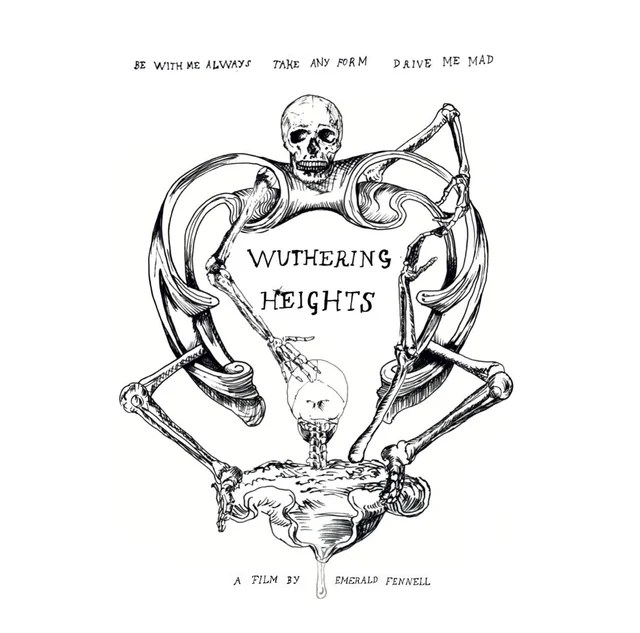
Author’s Note: * = Footnote
‘I am quite contented for myself–not as idle as formerly, altogether as hearty and having learnt to make the most of the present and hope for the future with less fidgetiness that I cannot do all I wish–seldom or ever troubled with nothing to do, and merely desiring that every body could be as comfortable as myself and as undesponding and then we should have a very tolerable world of itI am in the minority of people who actually enjoyed Emerald Fennell’s previous film, Saltburn. While certainly not original, I found the cinematography and atmosphere to be quite compelling. However, when it was announced that she was adapting Emily Brontë’s ‘Wuthering Heights’, I felt a pang of dread.’
—Emily Bronte, 31st July, 1845
The trailer dropping has sparked intense discourse surrounding Emerald Fennell herself, adaptations, and eroticism v. passion. To begin with the woman herself, Fennell comes from a very wealthy background. A private school alumni, her films often play with themes of power, money, and sex. She has faced much criticism for her portrayal of the working class in Saltburn. Given her background, I don’t believe she has a semblance of an idea about those without her privilege; yet she often claims to be detail-oriented.
When it was first announced she would be adapting Wuthering Heights, she claimed literature students won’t be happy. The casting director actually went so far as to claim there was no need to be accurate because “it’s just a book”. This immediately signified the kind of film it was going to be. This lack of respect for literature by some film directors isn’t new at all. I made my feelings quite clear about Yorgos Lanthimos’ treatment of Alasdair Gray’s book, Poor Things.
Choosing to adapt a beloved piece of literature is not a decision to be taken lightly. Your choices going forward highlight your values towards art as a whole. This is why it’s baffling for a casting director—someone who works in the arts—to dismiss the notion of being faithful to the source material. In my opinion, every film adaptation must have either the author on board or someone in the field of literature. To make a film out of something a few hundred pages long inevitably means sacrificing some things and stuffing others inside a snow-globe. Nobody is going to argue with this fact.
However, a problem unravels when you sew an arm to a severed head and still attempt to call it a corpse. After a test screening it was revealed that a man ejaculates mid-execution and a nun fondles a corpse with a visible erection; explicit acts that most certainly do not happen in the novel. Perhaps Emerald Fennell has mistaken the Victorian term “ejaculate”, meaning to exclaim, for cumming?!
While some argue that there are indeed sexual elements to Brontë’s Wuthering Heights, others believe there is nothing but passion, obsession and cruelty. As someone from the North of England—who also grew up in quite a small town—I understand how sheltered Emily’s life must have been. While I had the internet and the 21st Century to explore my needs and desires, she had nothing but the windy moors. From reading the book myself and knowing a bit about what we do know of Emily’s life, I am of the opinion that the book deals in many things but sexual desire as we know it. The Brontë sisters often felt suffocated by their surroundings—often wishing to travel—so can it be logically assumed that they had any notions of sex? While there are Victorian novels that do deal with desire of an explicit nature, Wuthering Heights is not one of them.*
Another pressing issue with Emerald Fennell’s adaptation is the whitewashing of Heathcliff. While she is certainly not the first to do it (see most adaptations), this intentional glossing over the racial aspects of Wuthering Heights in which Heathcliff is described as a “dark-skinned gypsy” with “black eyes and “a little Lascar” (a sailor from India or South East Asia). While he is later described as “white as the wall behind him”, this appears to be in context of his holding a burning candle close to him. Heathcliff’s race is still subject to much countenance today and is a key theme; both in the novel itself and at the heart of the recent discourse.
*In the trailer itself, neither Margot Robbie or Jacob Elordi’s accents sound at all Northern. There are shots of corsets, fingers in a fish’s mouth, the pulling of mouths and the fondling of egg yolk. But the casting itself is entirely wrong. Both Jacob and Margot are your typical Hollywood stars. Neither have features that could pass for the time period; not mentioning the fact that Jacob is white. Then we have the soundtrack, which is set to include the self-confessed brat, Charlie XCX—also a private school girl. A film like this requires classical and instrumental music to suit the period. Having a “brat summer” is as far from Emily Brontë as one could get.
As the film doesn’t release until Valentine’s Day next year (another questionable choice), we will only have these—and maybe more—things to judge the film on. This will not be the last of the discourse—far from it—but I hope we can finally learn from this hatchet job. People like Emerald Fennell don’t care about the preservation of art; only what it can do to line their pockets.
*Some argue that the grave digging is erotic, but there is much countenance to this also.
*Many have pointed out the quotes around Wuthering Heights as a way to dismiss criticism, but if you look back at posters for films such as Gone With the Wind, this was common. Therefore, this is a stylistic choice by Emerald Fennell as opposed to one of intention.

 Courtenay's Corner