Author’s Note: These entries are typically relayed as a play-by-play, but this month’s (and possibly continually) will be a collage of the journal entries and fragments I have gathered throughout the month of February.
* * *
“Of her still body. . . there sprang a little blaze. . .
A pack of hounds, the flame swept up the flue!—
And the blue night stood flattened against the window,
staring through.”
—Edna St. Vincent Millay
“A writer’s promise is like a tiger’s smile”
—Lytton Strachey
* * *
At witching hour on the 2nd, I woke up to my mother saying, “Mum is blue. I must get to her. Oh, god, I need to go.” Nana was being rushed to hospital, and because of my own health issues I wasn’t able to go. Though, even if I was in good health, I would need to look after our cat, Barney. I spent hours wondering if I didn’t have my nana anymore, all the while being bombarded on Substack by the reactions to my discourse-starting statement.
The note I wrote about disliking lower case essays had gone viral, and instead of receiving a good debate, I was called “a weirdo”, “a loser”, and a “mean-spirited person”. Our capacity for criticising our peers is sorely lacking. The note itself—contrary to popular belief (and in spite of its length)—was written in just under two minutes. You can blame this on my fast mind and fast thumbs (get your laughs in now). Many folk were operating under the assumption that I was rocking back and forth, “shut as a seashell,” to quote Plath, but I was quite happily (prior to family matters) going about my day.
Additionally, I had a swathe of people trying to educate me on the usage of lower case by writers such as bell hooks and e.e. cummings, as though I am completely unaware of those authors or their intentions. As a poet, it would be criminal if I didn’t know cummings! These writers using lower case does not negate my dislike for it, nor does it push me to believe it is revolutionary now. At the time, bell hooks refusing to capitalise her name was something to speak about, but when you overfill a pool, it is rather difficult to see any type of water as sacred. And in fact, the very last lines of the note was intended to be slightly humorous:
“I am starting to believe that reading an article in all lower-case gives you an almost
drug-induced haze. And some might suggest I try writing such an article, to which I
respond: I did. The end result was as disappointing as accidentally breaking the yolk
when frying an egg.”
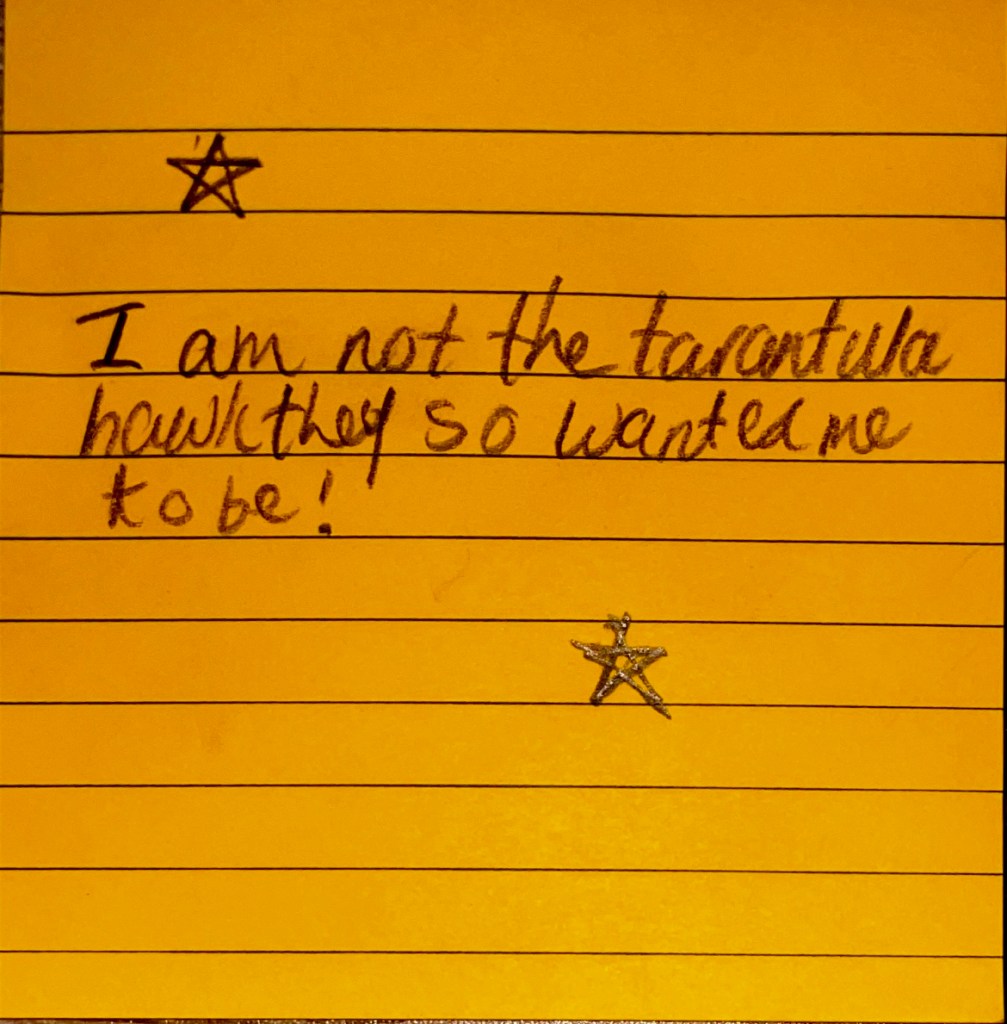
But to state the obvious, this all went down rather sourly. I am not the tarantula hawk they so wanted me to be. Neither am I an older woman (as some have presumed) ‘hating’ on my younger counterparts. One of the writers I mentioned in the essay took a significant umbrage with my decision not to tag her, but any critic knows it is not good form to do so. When you write a negative book review, you don’t tag the author, do you? But in the eyes of others, I am a coward, the devil incarnate, or some creature in a hovel.
There is nothing like a righteous being pumped up with glorified fire. Post-response, many applauded the writer for her ‘takedown’, for standing up for herself (as though it was ever an attack). Yet she claims she believes “I am good at playing the victim,” without caring to know a single thing about me beyond my off-the-cuff Substack note. Not once did I make assumptions on character, only the stylistic choices I saw. And when I reached out to extend an olive branch, the author was less than forgiving. Despite my reiterations that there were no hard feelings, and my attempts to de-escalate the situation, she continued to see me in a poor light.
What is most interesting about this whole thing is that it’s the first time I’ve been on the other side of a discourse. I make no bones about my imperfections, missteps, and fallibilities, but I too am prone to assuming the worst. This discourse has provided me with a new perspective for which I am grateful. Perhaps I have judged harshly another whose off-the-cuff criticisms (designed to entertain) have been cast in a vacuous blackness. However, there is one distinct difference: I don’t accuse people of unbridled envy. If a woman criticises another woman, it is often assumed she is envious, but isn’t that in itself an unfeminist way to look at things? Why can’t we critique each other without being accused of lacking something? I have always been against the notion that all women have to get along because of their shared sex.
At my most delicate, I cried about the discourse; partly because of the commenters who fundamentally misunderstood me and because I might be losing a staple figure in my life—my nana. After a few snotty tissues, I picked myself up and focused on what was most important at the time. It was only hours later when nana had been stabilised that I could self-reflect. I asked myself if I regretted any of what I originally said, and I came to the swift conclusion that I didn’t. I stand by my belief that I was never mean in my post, harsh maybe, but never cruel. When the year began, I maintained my desire to dive headfirst into writing more criticism, and I have certainly started with a bang.
All I had to do was remind myself that this will all blow over. Standing firm, I have not walked back on anything, nor have I deleted the post; you can search for it if you wish. Aside from the odd like or restack calling me a loser, things did calm down. As for my nana, she is doing ok, and it’s a miracle she’s still with us. With all of this, it is glaringly obvious that we have a crisis of criticism. To critique your peers is now tantamount to punching them in the face and spitting on them. But I was like that once; when I misunderstood the purpose of critique and how to do it with a semblance of intelligence.
This speaks to the assumptions I mentioned earlier. This criticism was presented in a note because quite frankly, it didn’t warrant one. I saw comments about “wasted energy” on a “lengthy rant” which was really a couple of paragraphs. It does worry me that a few paragraphs that took me approximately two minutes to dash off is considered laborious. It is at times like this that we must get comfortable with being misunderstood. I will not pull on a sinking anchor. The unintended positives (contrary to what has been said) of the discourse are new followers, new eyes, and new tools to better equip myself.
In a month of discourse, family matters, chronic pain, I have been delighted by the most frustrating writer’s block. Last November, I watched Karen Moncrieff’s Blue Car, and I was inspired to write a poem similar to the main character about my father leaving the family home amidst divorce. The poem kept pausing at five lines, so I put it to one side. Three months on, I wrote a completely different poem called Where Flowers Give Birth to Snow. I was under the impression that I had broken the banks, but that has not been the case. Since then, I have completed two more: Bananas and Cannibal Queen. It has been such a strain, however, that I still haven’t got my mojo back. My solution to this is to keep my toes treading the poetic waters by writing a lot of criticism and analyses.
Throughout February, I have been reading the letters of Ted Hughes. While many Plath fans write him off completely, I feel it is important to get the whole picture. But make no mistake, I loathe how he treated Sylvia, and how he adopted the role of ‘long suffering husband’ after her death. Just like my writing, I have been dragging my feet with reading, but I am going to change that in March. I have two books coming in the post: Rapture and Melancholy: The Diaries of Edna St. Vincent Millay and The Madwoman in the Attic by Sandra Gilbert and Susan Guber.
I pondered my own rapture and melancholy when I thought of the sheer amount of money spent on trying to further my career. There are so many paywalled opportunities in the writing world, and it really shouldn’t be this way. Let’s say I enter ten competitions per year, and the price to enter is £10 (which is typical of a few places), I will have spent £100! These days, there are so many people unwilling to help out without monetary compensation. It’s become incredibly difficult to make a name for yourself, and with people paywalling their supposed time and effort on opportunities that could help someone else, there are less success stories. It’s a depressing fact to contemplate, but this is our reality. This is a reason why I keep my Substack free to read. Though, if anyone is so inclined, they can subscribe as a way to support me, but none of my posts are behind a paywall.
And right at the end of this month, I watched Christopher Hampton’s Carrington. The film follows the bizarre yet endearing relationship between Dora Carrington and Lytton Strachey. What fascinating characters these people were! I am working on sourcing a copy of Strachey’s letters. All I have found so far is a PDF of letters between him and Virginia Woolf. However, Lytton Strachey’s famous book, Eminent Victorians, is much easier to find, and I will be reading it in due course.

 Courtenay's Corner