
Stephen Spender, W. H. Auden, Ted Hughes, T. S. Eliot, and Louis MacNeice at Faber and Faber cocktail party honoring W. H. Auden, photograph by Mark Gerson, [23 June 1960]. [EMORY]
“Some say the world will end in fire / Some say in ice.”
—Fire and Ice, Robert Frost
Last year’s National Poetry Competition was won by Imogen Wade with her poem, The Time I Was Mugged in New York City. The piece itself is reminiscent of the popular writing style of today; prosaic and rather simplistic. Following her win, Angela Patmore wrote an article called, The Poetry Society has betrayed poetry:
“The first two prizes have been awarded not to poetry at all, but to prose, printed in central blocks on the page, evidently under the impression that this makes them something other than prose.”
It is clear that Patmore was rather unhappy with Wade’s winning entry, and while her views were expressed in less polite terms, she brought up some interesting points. Ever since the Rupi Kaur boom, poetry has become less image focused and far more aphoristic. Personally, the poetry I enjoy writing and reading is *highly metaphorical and complex: think *Sylvia Plath, Robert Frost, William Wordsworth, etc.
While I have been lucky enough to be published in many journals, I still find it difficult finding the right audience for my work. There are an eye-watering number of poets around, and most of them are rather modern leaning. If you read the letters of Sylvia Plath, she was publishing in the New Yorker (a place I now suspect commissions at least 90% of their work)! Becoming a household name seemed much easier then, but that wasn’t for lack of poets. Back in the ‘50s, poetry was on a level playing field with novels and short stories, unlike today where fiction has the monopoly.
When I was just starting out, it was a wasteland of a place; a wild-western. Tumbleweed rolled by at the mere mention of poetry publishing. All the articles I read advised publishing in journals, but they took care to mention that “nobody cares about poetry anymore”. If you want money, fame and glory, they said, write a novel. There really weren’t many hopeful prospects at the time, but that didn’t keep me from writing.
Now, things have changed. Poetry is much more popular than it was, but the audience for traditional work is few and far between. Out of all my influences, I write most like Ted Hughes and Sylvia Plath. Because of this, I go through many more rejections than most. Last year, I wracked up seventy rejections and just four acceptances. Additionally, I didn’t place nor win any of the competitions I entered. One rejection that stood out to me was my personalised one from The London Magazine.
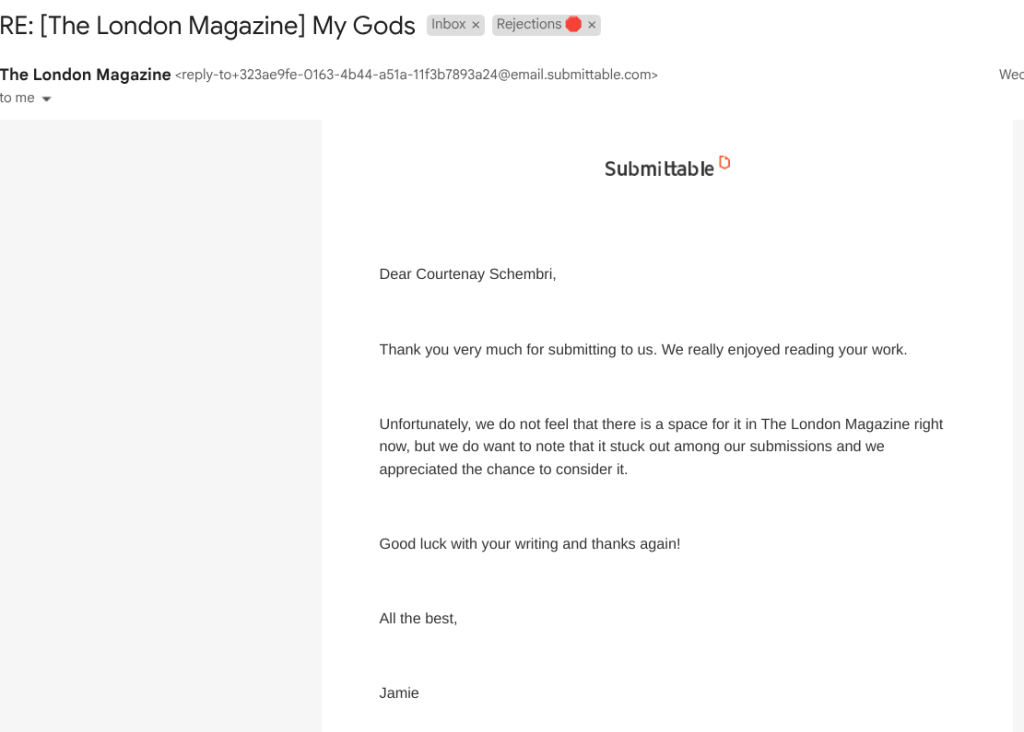
If trying to be noticed wasn’t hard enough, then being a confessional poet in the 21st Century definitely makes it harder. But a fancy, poetic style is what I adore the most. I wasn’t called “Dictionary Girl” in primary school for nothing! Some people might suggest I regain a modern sensibility, but what I do best is blend the traditional with the contemporary. In one poem of mine, I reference some designer brands, and in some others I may mention current locations.
Going back to Imogen Wade’s winning poem, I recognise that the topic is of course terrifying, but that fear is (in my opinion) not shown throughout the poem. While Angela Patmore described the piece as “nothing more than a diary entry,” I am able to recognise it as a prose poem. However, I find the lack of ambition to be quite saddening. Wade fails to give life to the colours she employs, as in, “A man came up to me, dressed in black.” One might argue that this conveys a sense of detachment one might feel after being mugged, but I am unconvinced that this was the author’s intention.
What baffles me the most are the judges comments:
“An extraordinary and thought-provoking poem, whose paradoxical lyricism in the account of an abduction demands reading and re-reading.”
I don’t see any semblance of lyricism whatsoever, and while I can reluctantly agree that it provokes some thought on account of subject matter, I cannot abide by its supposed extraordinary nature. In frank terms, I find the poem to be woefully unambitious, which is a real shame given the length one could go with such a subject. At risk of sounding presumptuous, Wade’s line, “I entered JFK with a red suitcase and no one to greet me,” could be improved by associating the colour red with something specific: whether that be a lipstick she wears or a ladybird that may have rested on the van’s window. *Re-written it might read:
“I entered JFK with a red suitcase and no one to greet me / Like the ladybird that would come to rest on his window.”
For me, this additional detail would conjure a stronger image in my mind, thus allowing for a stronger grip on the poem. In her poem, Elm, Sylvia Plath wrote, “And this is the fruit of it: tin-white, like arsenic,” which illustrates just how much you can do with colour. If Plath had written, “And this is the fruit of it: white,” it wouldn’t have the same piercing effect.
But there is no denying that Imogen Wade’s style of writing is very much in demand, and there is little call for more traditional work. This isn’t to say I have never published because I have, but I find myself receiving comments about being *“too obscure”. It seems that some journals I have approached greatly underestimate the intelligence of their readers and their propensity for metaphor.
What does this mean for the future of traditional poetry? Well, if we continue to prop up poems in the style of Imogen Wade, it will become increasingly harder to find homes for imagistic work. More than that, I fear it will further alienate people from discovering the works of Robert Frost, Sylvia Plath, Ted Hughes, W. H. Auden, etc. Personally, I am willing to continue to write and publish highly complex works that spark a bonfire within me, and I will rave about poets of the past to anyone who will listen.
Poetry is an ever evolving entity; what is popular today will be old news tomorrow. It is my hope that people will come to rediscover the magic of metaphor and symbolic work instead of being afraid of it. T. S. Eliot said, “It is one thing to write in a style which is already popular, and another to hope that one’s writing may eventually become popular,” and I completely agree. All we can do is critique our peers, self-reflect on our own work, consult a thick thesaurus, and do our best to be good.
Footnotes:
*: I realise how obnoxious this sounds, but I take my leave from the traditional, from what some would call “the old and stuffy”.
*: Take a drink every time I mention Plath.
*: Bear in mind that this is merely an exploration of what the poem could look like. This is not to be obnoxious, and Wade’s poem remains hers; this is an exercise. It is important to engage in critique of our peers.
*: A piece of feedback I received upon a competition loss.

 Courtenay's Corner
1 Comment