Ten years ago, I was sitting in my media studies class, buzzing with the urge to run away. I had just visited London for the first time, was deeply obsessed with BBC Sherlock, and all I craved was spontaneity. It’s the ever cloying cliché of the small town girls dreaming of the big city lights. When life feels like steering a ship through mud, a self-imposed exile may just be what you need. In his diaries, Franz Kafka speaks of the bachelor and his property as “not one but two,” thus making the distinction between owner and subject. He goes on to say that “whoever destroys the connection destroys him at the same time”. These umbilical ties often play into how we see ourselves within the context of our surroundings. And rarely can anyone articulate this more efficiently than Eva Baltasar.
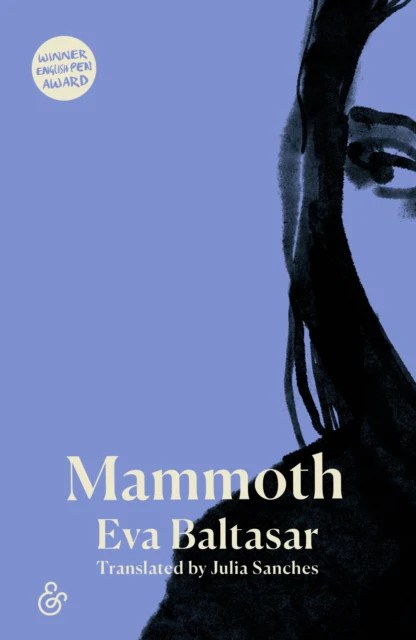
Her books are usually translated from the Catalan into English by Julia Sanches. Baltasar’s previous works, Boulder and Permafrost, were published in 2018 and 2020 respectively. Her latest offering, Mammoth (again published by & Other Stories) dropped into bookstores at the beginning of August.
The opening epigraph to Mammoth comes from Les Murray’s Subhuman Redneck Poems—
“An idea hungers for your body.”
Les Murray was an Australian poet whose own mother died following a miscarriage after the doctor failed to call for an ambulance. This fact is key in the broad brushstrokes of Baltasar’s latest novel. To consider an idea as an entity is to contemplate gestation. During pregnancy, a lot of people feel insecure about their bodies growing in size—some may compare themselves to the titular mammoth. Alternatively, something mammoth can allude to a daunting task. Whichever way you look at it, a certain monstrousness is an ever present thread.
Just like there are three trimesters in pregnancy, Mammoth is separated into three parts. Our unnamed narrator immediately expresses her desire to fall pregnant—
“On the day I planned to get pregnant, I turned twenty-four and threw a birthday party that was actually a fertilisation party in disguise.”
Our protagonist is unapologetic in trying to achieve her dreams. She will do absolutely anything to get what she wants, and this is in part due to her recurring feelings of isolation. Picturing herself as “a rodent dwelling on the forest floor,” our protagonist is sick of serving others. Eventually growing tired of the city, she escapes to the country. Her decision to move to a rural area is a self-fulfilling prophecy. When we feel alienated, we subconsciously surround ourselves with things of that nature.
In an interview with Granta, Eva Baltasar discusses her experience with landscapes—
“I’ve never been able to love a city. Or a house. I can love a room, if it’s small enough. I have the feeling that a house never allows you to inhabit it entirely. There’ll always be a corner, a tile, an angle that remains completely unknown, for whom we will never be anyone.”
Reading the rest of the interview, the parallels between Baltasar and the women she writes about are explicit. Noting that when she is alone, Eva knows, “…that no one will ask me for anything, that I don’t have to be there for anybody, just for myself, in that small patch of time,” In Mammoth, the weight of expectation placed on women is at the forefront. More generally, there are times when all we want is silence. From birth we are pushed into fulfilling our potential—the one prescribed by teachers, guardians, and society itself.
Taking control of one’s own life can often be difficult, and Baltasar shows this by moving the narrative from the city to the country—
“The flat was a stage, a public square, the agreeable waiting room of an experimental lab.”
In her city apartment, the MC feels as though things are just happening to her. Her decision to fall pregnant is not yet her own, despite the ramifications it will have on her body. So when she moves to a rural area, she tries to play an active role in her own life by seducing strangers, nursing lambs, and battling stray cats. The role of a mother is within reach. Befriending the shepherd is truly what propels this story forward. A cleaner at first, the protagonist soon becomes “his whore”. He pays for her services, a lonely man with manure-flavoured semen.
As the months go by, the isolation grows into a terrifying creature: the night described as, “a temple of truth, a bellowing god.” And our main character seems to inch closer and closer to her greatest desire. By becoming pregnant by the shepherd, we continue to fall into this biblical allegory—
“Because at night bedrooms are stables where the past is regurgitated and chewed over.”
While the story of the nativity ends happily, Mammoth does not. The novel wraps itself up in violence and dissatisfaction. Sometimes, what we want is not what we need, and our protagonist soon realises this—
“I’ve held an enormous question mark in my arms.”
Many people believe that children will save them; whether that is the next generation or by having their own. Intentionally bringing new life into a bad situation is certainly fuel for a wider conversation surrounding anti-natalism and the state of our ecosystem. However, I don’t believe this is what Baltasar intended, but is perhaps a further topic of discussion. Mammoth focuses on the land—
“…in the mountains, the land belongs to life and life is the animals.”
Mammoth is a book about self-imposed exile in periods of alienation, thus choosing to be alone rather than others believing you to be. In Baltasar’s other works, the characters are sailing on merchant ships and working as au pairs in Scotland. Eva herself currently lives in a Catalonian village way up in the mountains. Though we live in a far more progressive world, bigotry is just as rife as it was forty years ago. We have public figures fuelling the fire, speaking out ignorance and fear. Perhaps this is a unique form of isolation, specifically regarding becoming a mother as an LGBTQIA+ person.
When I first read the book, I immediately noticed a departure from her other works, though the running threads are there. In Permafrost, the protagonist says, “Life belongs to others,” as does our MC in Mammoth—
“I call for everything that was once mine to be turned over to life, for it to find a path of its own in this bitter, inhuman life, because it isn’t mine anymore.”
In Pink Floyd’s film of The Wall, we see flashes of isolation in Bob Geldof sitting in a chair, the children in masks, or banging at his own wall. In the song, The Thin Ice, Roger Waters sang, “If you should go skating / On the thin ice of modern life,” which is akin to Baltasar in her belief that nothing truly belongs to us. Ice is naturally fragile, and we often mistake our weight, thus crashing into the freezing cold. As the author poses, is life truly our own? Even as they attempt to rebuild the wall, can something belong to us if it is so easily broken by external forces? It can be argued that this is what Baltasar’s protagonist tries to do by escaping the city in favour of the land.
In my opinion, the country makes for a wonderfully suffocating feeling in stories. By moving the story from the city to the land, it affects us in ways we understand. Most of us are familiar with the need to escape, to find a place where we are free to lose our minds. Eva Baltasar is adept in balancing the lyrical with the sparse—like a baby with Nabokov and Carver as parents. Though I understand some things are naturally lost in translation, Mammoth is one great heart palpitation of a novel. Julia Sanches has done a fabulous job with all of Baltasar’s work, and I eagerly await the next one.

 Courtenay's Corner