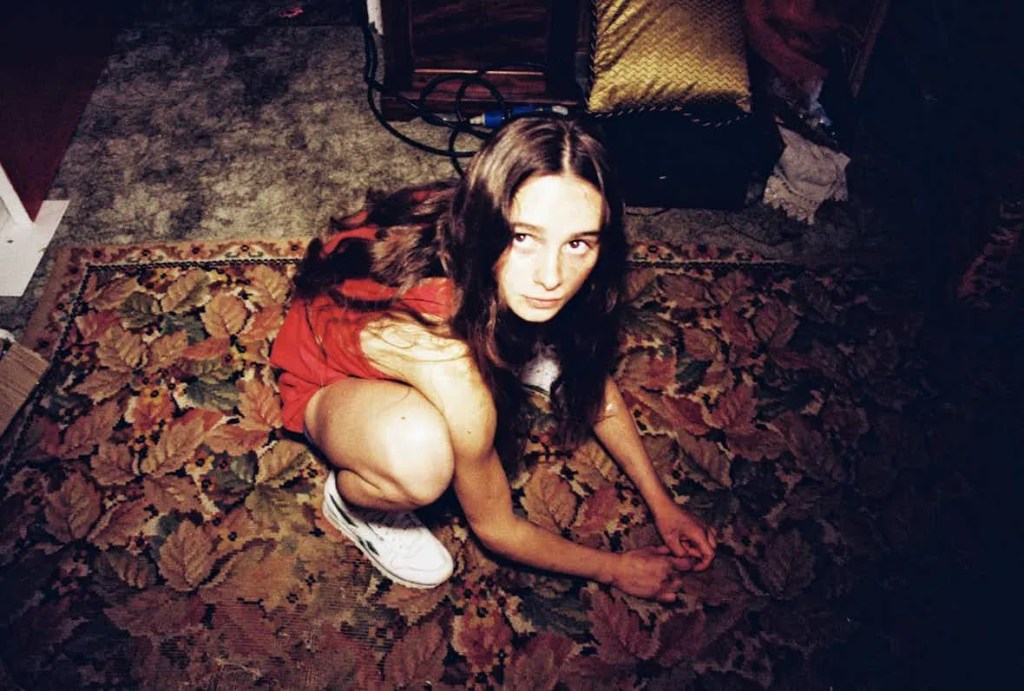
Film: Hoard (dir. Luna Carmoon)
Run Time: 2h 6m
Rating: ★★★★★
“I murdered my mother, you see,” is how Luna Carmoon’s film, Hoard, begins. Set in the ‘80s and ‘90s, a softly toned voice speaks over increasing darkness balanced out with flashes of light. We aren’t sure of what is going on or where we are, but we understand that we’ll know soon.
The opening scene is of a woman (Hayley Squires) spinning a young girl (Lily-Beau Leach) around in a trolley as she dons a glittery top hat and a fur coat. They sing the nursery rhyme: “I’m the King of the castle, you’re a dirty rascal.” Other kids run past holding lit fireworks as our main character roots through the bins for various objects. And that’s just it—the objects of our desires.
Hoard is a film that toys with the acts of play, rhyme, myth, and primality. This isn’t just a film about hoarding, it’s an exploration of the Peter Pan complex. Maria comes home from school with her lunchbox full of old food and trinkets that Cynthia, her mother, wants to keep. When Maria pretends she didn’t bring the tin home, her mum becomes anxious, scratching at her neck. This mother-daughter relationship is incredibly vivid for how little time we spend with it. Hayley Squires brought her character to the forefront, truly embodying people like Cynthia, but in a way that doesn’t lead with disgust. The conversations and visuals surrounding hoarding are flies, rats, dust, and more sickly things. Carmoon shows us that it doesn’t have to be that way.
The latter half of the film sees Maria with her foster mother, older and far more animalistic than she was on the day they took her away. Saura Lightfoot-Leon, who plays older Maria, uses movement as a way to express her character—to show the connection between body and soul. Maria is an animal, a creature of magnitude. She lets saliva fall onto the pop rocks in her hand and she eats the concoction with glee.
When Michael (Joseph Quinn), a previous foster, comes back to stay, Maria sees herself in him. Together, they introduce themselves to their inner children; running around the living room on all fours, growling and screeching. Maria and Michael remind me of Cathy and Heathcliff. Childlike wonder permeates the veneers and offal of this feature. But I keep coming back to the beauty of objects, as Hoard gives as a poignant message. When I think of my own mother, I think of her signature scent, Cabotine De Grès, on the nightstand. I think of her nightgowns with cows and sheep on. I think of when she used to keep liquorice blackcurrants in her handbag.
There are many recurring symbols that connect older and younger Maria, such as a tin drum. She was named after the book / film, The Tin Drum, as mentioned by Cynthia earlier. When older Maria finds a homeless man holding an identical tin drum, she flashes herself at him in return for it. Upon acquiring it, she bangs the drum rhythmically to the sound of the passing train, just like the main character of The Tin Drum does when upset. Using this other piece of media as a foundation for her feature is an interesting move by Luna Carmoon.
Naturally, the way this film is shot is very dreamlike. In an interview with BFI, Carmoon said she would secretly spray unusual perfumes around the set to create the atmosphere she wanted. The perfume house, Etat Libre D’Orange, creates unique scents such as Fat Electrician and Exit the King. Hoard is a true sensory experience. Fluidity is a style of film making I find far more fascinating. As I said, movement is a recurring theme, and that is reinforced by the non-linear structure.
The acting in this film is extraordinary, specifically Saura Lightfoot-Leon’s who plays older Maria. The depth with which she feels the emotions is something you rarely see on screen. I really believed she was Maria. Joseph Quinn was also brilliant as his character Michael, particularly during his more vulnerable scenes. The hurt he is going through is so palpable you can smell it.
After watching Hoard, I discovered Luna Carmoon’s two previous shorts, Nosebleed and Shagbands. Both can be seen as precursors to the full feature: exploring the inner child through characters wearing tamagotchis on lanyards (I did too) and shagbands (the memories). Luna Carmoon is around the same age as me, so there is somewhat of a kinship in the cultural references she makes.
Overall, Hoard turns the conversations surrounding childhood and hoarding on their heads. Hoarders are often portrayed as disgusting, with their dirty plates and encrusted food, but Luna Carmoon adeptly shows us how different the reality can be.
“Feed the grief, Maria.”

 Courtenay's Corner